
 Knowledge CenterArticlesDispatches from the Road: Women’s Polit… Dispatches from the Roa…
There’s a stretch of Route 82 in the Mississippi Delta where the landscape feels wide open. Fields run long in either direction. Towns appear and disappear quickly. And if you’re moving fast and not paying attention, you might miss what’s there.
Over four days in March, I traveled by bus across Mississippi—from Greenwood to Jackson to Hattiesburg to Biloxi—alongside organizers, funders, and community leaders on a learning and engagement tour organized by the Mississippi Alliance. Together, we explored Mississippi’s rich civil rights history and met with leaders and organizations shaping the state’s civic engagement landscape today.
As part of The Ascend Fund's work to support women’s political leadership at the state and local levels, I joined the Mississippi bus tour to listen, learn, and better understand how Mississippi’s organizing ecosystem helps people come together and turn their shared priorities into real community change.
In the Delta, we visited sites connected to the civil rights movement, including the Sunflower County Courthouse in Indianola, where Fannie Lou Hamer first filed paperwork to run for U.S. Congress in 1964 during Freedom Summer. Civil rights activist Charles McLaurin, who served as Hamer’s campaign manager, joined us on the tour to share personal stories of his time working with her.
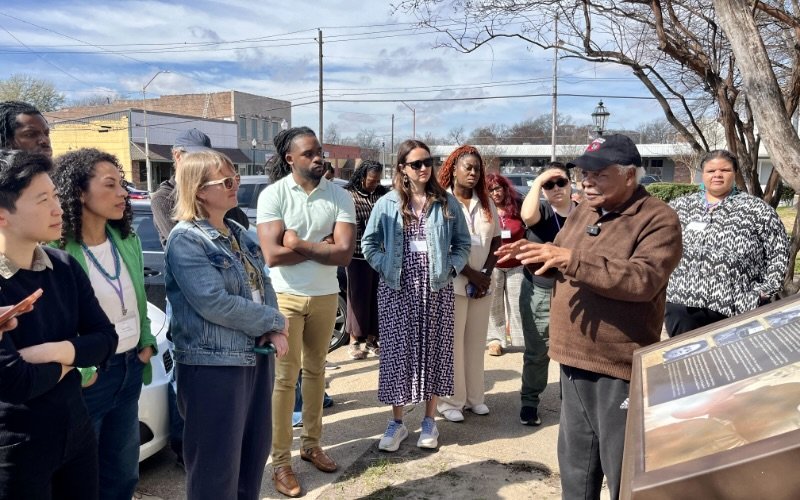
Charles McLaurin, civil rights activist and Fannie Lou Hamer’s campaign manager, shared his experience working with her.
Hamer was a wife and mother whose lived experience of racial discrimination and economic injustice working on a sharecropping plantation, including being denied the right to vote, led her to a breaking point. She chose to step into political life and challenge the systems that had long excluded her and her community. Hamer’s decision to walk into that courthouse to register to vote in 1962, and later run for office, were bold acts of defiance. They were also assertions that she belonged, and that our shared government belongs to all of us.
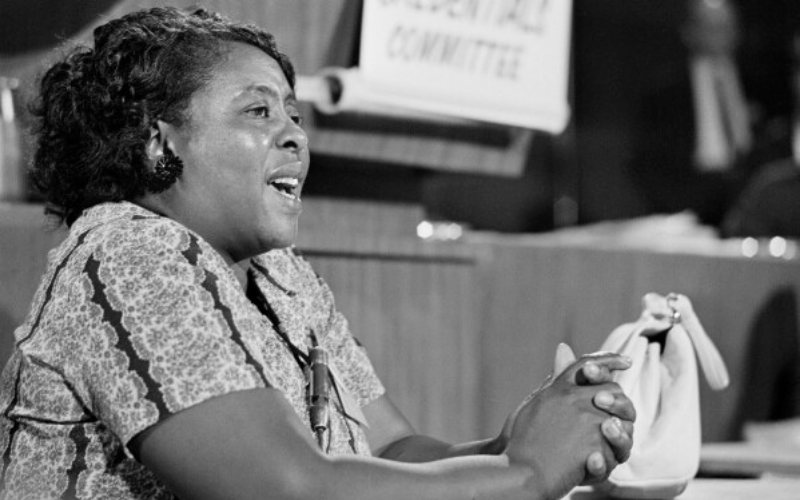
Fannie Lou Hamer speaking before the Democratic National Convention in Atlantic City, N.J., on Aug. 22, 1964. Photo credit: AP
From those early moments in the 1960s, she stepped into a level of public leadership that would go on to profoundly shape both the American civil rights and women’s rights movements. Though she did not win that first race, her impact extended far beyond a single election. She did so while facing nearly every systemic barrier imaginable, including targeted acts of political and state violence.
Standing outside the courthouse where Fannie Lou Hamer’s political leadership story began, I kept coming back to one thought: it all started with one woman’s decision to step forward. It made me wonder what it takes today to ensure that other women like her have the resources and support to pursue public leadership roles and serve their communities for the long term.
Hamer’s story is an important historical reference point, and part of a much longer continuum that shapes how organizing for women’s political leadership, especially for women of color, happens across Mississippi and the country today. That throughline showed up at every stop on the tour through Mississippi.
In Jackson, leaders from organizations like One Voice and The Ascend Fund partner Mississippi Black Women’s Roundtable spoke about the day-to-day work of building women’s political power, including what it takes to reach people, build trust, and sustain civic participation between election cycles.
Initiatives like Mississippi Women in the Lead are expanding state and local leadership pipelines as alumnae run for positions on city councils, school boards, and county commissions. These leadership roles are often the most accessible entry points for first-time candidates and play a critical role in building a long-term bench of leaders. Just as importantly, the program has fostered a network of women supporting one another through professional development, resource-sharing, and community engagement.
Across Mississippi, conversations about women’s political leadership cannot be separated from conversations about rural healthcare access, economic opportunity, and racial justice. Communities are navigating the long-term effects of disinvestment, and state and local governments that do not always meet people where they are.
And still, organizing continues—not as a reaction to a single election cycle, but as steady, ongoing work rooted in relationships, community, and a long-term vision of a more representative and responsive democratic system that truly works for everyone.
Spending time on the ground made something else clear. While Mississippi ranks 48th in the country for women’s political representation, the state’s story is infinitely more powerful than this ranking. Across the state, women have been leading, organizing, and building the infrastructure for women's civic engagement and leadership for generations. The gap is not a lack of leadership. It is a lack of sustained funding investment in the systems, organizations, and programs that support women’s civic participation, leadership development, and pathways to public service.
For donors committed to advancing women’s civic leadership and representation across the United States, investing in Mississippi and the Deep South is essential. It also means addressing the interconnected barriers women face in their daily lives—from healthcare access to racial justice to economic stability—that ultimately influence how they can engage civically, run for office, and lead.
The foundation is already there. Organizations across Mississippi are building leadership pipelines deeply rooted in community. At The Ascend Fund, we believe investments in women’s political representation at the state and local level are critical to driving broader gains nationwide. With greater funding, this work can grow, strengthening not only Mississippi’s leadership landscape, but the future of representative democracy itself.
"Across Mississippi, women have been organizing, building, and sustaining their communities for generations. Our collective role is to invest in the organizations, networks, and leadership pipelines that enable more women to step forward, pursue public leadership roles, and serve their communities over the long term. We know that when women lead, all of us do better."
One of the most powerful parts of the Mississippi bus tour was hearing directly from organizations doing the day-to-day work of advancing women’s civic engagement and political leadership. Below are a few of the groups we learned from on this journey. We encourage you to learn more about their work and consider supporting them directly:
Learn more about The Ascend Fund
 Your Vision
 Our Platform
 Real impact
Panorama Global is a member of The Panorama Group.
Privacy Policy © 2026 Panorama Global. All rights reserved.
 Contact Us
 Search
 Join Our Mailing List